
Ever leaned over to snag your seatbelt, tilted your head toward your shoulder, or reached down by your foot for a bag? That’s lateral flexion in action. Some folks call it side bending, side flexion, or lateral bending. It’s all the same move.
Here’s the thing: most people train their “core” like their body only moves straight forward or backward. Real life’s messier than that. Your spine and trunk twist, bend, and shift every which way—and side bending (lateral flexion) is a big part of how you actually move.
So, what is lateral flexion, really?
It’s when you bend a part of your body to the side. You see it most in your neck and spine. Like when you drop your ear toward your shoulder or do a standing side bend.
Here’s a quick breakdown: “flexion” just means you’re closing the angle between two body parts. “Lateral” just means “to the side.” So, lateral flexion of the spine? That’s just side bending your spine.
A quick heads-up: some people search for “lateral extension of the spine.” That’s not standard anatomy lingo. The right term is still lateral flexion, or just side-bending.
Where does lateral flexion happen?
When people talk about lateral flexion, they usually mean the spine. But side bending shows up in a few places:
1. Neck (cervical spine): This is the classic side-to-side tilt of your head. It often works together with neck rotation—like when you glance over your shoulder and dip your head a bit.
2. Spine (thoracic and lumbar): The thoracic spine is your upper and mid-back; lumbar is your low back. People search all sorts of things for these spots: “thoracic spine lateral flexion,” “lumbar spine side-bending,” “torso lateral flexion”—it’s all about side-bending your back or trunk.
3. Hip (coxal joint): Here, the movement is technically called abduction or adduction, not lateral flexion. But people still type in “hip lateral flexion” or “coxal joint lateral flex.” Just think “moving the hip sideways.”
4. Shoulder: Your shoulder doesn’t really “laterally flex.” What people usually mean is moving the arm out to the side (shoulder abduction) or leaning your trunk sideways while your arm stays up.
Which muscles make lateral flexion happen?
A “lateral flexor” is just any muscle that helps you bend to the side. The main ones for your trunk:
- Obliques (internal and external): These are on the sides of your abs. They help you side bend and rotate.
- Quadratus lumborum (QL): This deep muscle in your lower back really drives side bending in your lumbar spine.
- Intercostals: These run between your ribs. They help your ribcage expand and can chip in with side bending, too.
For the neck, it’s a team effort. Different neck muscles pitch in depending on how you’re moving and which way you’re bending.
If you’re after a quick list of the muscles that flex the trunk laterally, the three above are your main players.
How much should you be able to side bend? (Range of motion basics)
What’s “normal” can swing a lot depending on your age, body shape, and how much you move. But here’s a ballpark:
– Neck (cervical) lateral flexion: Around 20 to 45 degrees to each side. That’s what most sources say.
– Thoracic and lumbar spine: This one’s trickier. Studies use different ways to measure, so numbers jump around. One classic method (using a tape measure) found that healthy young men could laterally flex their dorsolumbar spine about 10% of their body height.
Don’t get hung up on chasing the perfect number. Instead, watch for big differences from side to side, pain, or weird compensations—like twisting, leaning forward, or ribs flaring out.
One sneaky sign you’re restricted: the lateral shift.
If one side of your body feels stiff, you’ll often avoid moving that way without even realizing it. Your body kind of cheats—shifting away from the tight side. Let’s say your left side-bend feels stuck. You might shift your pelvis right or twist a little to fake the motion. People call this a lateral shift.
This stuff matters. You might think you’re getting better at side bending, but if you’re not careful, you’re just getting better at finding ways around your restrictions.
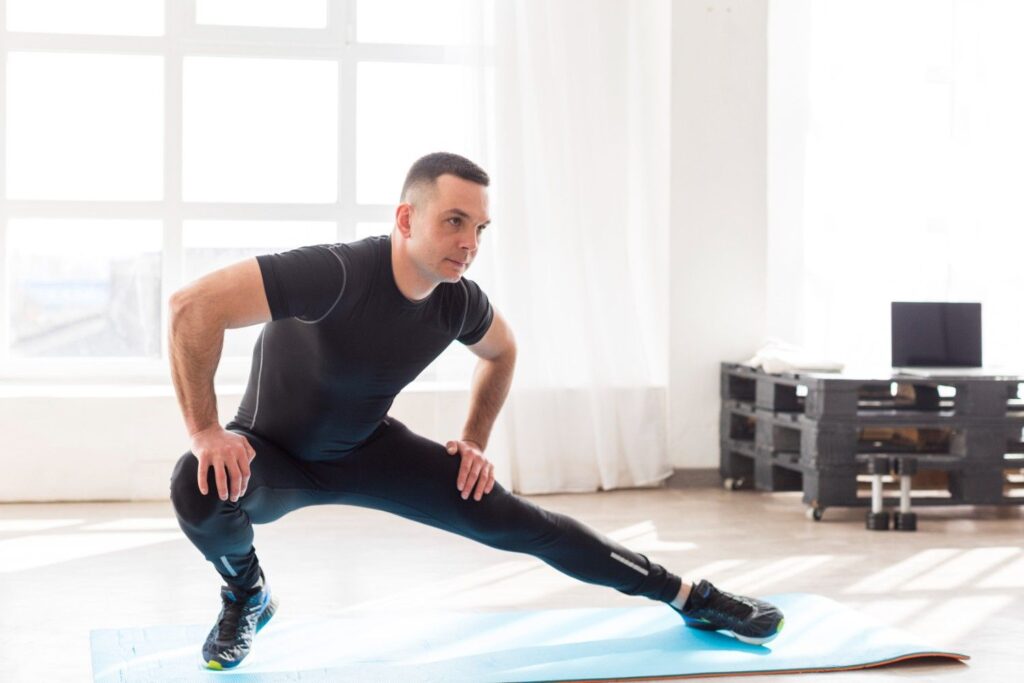
Why does lateral flexion get limited, and what’s going on when it happens?
Your spine’s ability to bend to the side can get blocked for a bunch of reasons. Discs, vertebrae, nerves, old injuries, and other stuff—these can all mess with your mobility. But honestly, in most everyday cases, it’s not some scary diagnosis. Usually, it comes down to things like:
- Sitting too much, especially if you always favor one side (so one side gets tight)
- Weakness or poor control when side-bending (your body avoids the range it can’t control)
- Stiffness in your ribcage (believe it or not, how you breathe matters here)
- Poor hip stability (your pelvis starts moving instead of your spine)
But if you notice numbness, tingling, pain shooting down your arm or leg, or anything weird after a fall or injury—get checked out by a pro. Don’t mess around with that.
How to train lateral flexion: mobility, strength, and control (without wrecking your back)
A smart approach to training this movement covers three things:
1. Get the range.
2. Own the range.
3. Use it in your real life.
A) Mobility and stretching
If you just feel tight or “stuck,” start here. Try these:
– Standing side and hip stretch—just a simple side bend.
– Side-lying reach and breathe—lie on your side, reach your top arm overhead, and inhale deeply into your open-side ribs.
– Gentle lumbar side stretch—hold a door frame, sit your hips back a little, and shift your ribs away from the frame until you feel a mild stretch.
– Lateral lumbar stretch with support—kneel by a bench, put your forearms on it, walk your hands to one side, and breathe into your opposite ribs.
And hey, if you can’t breathe calmly while stretching, you’re probably pushing too hard.
B) Strength and “loaded mobility”
These moves build strength and actual usable range—not just a loose, stretchy feeling.
Some good options (thanks to Markow Training Systems):
– Dumbbell side bend with a hip shift
– Side bend on a bench
– Hanging side bend
– Half-kneeling side bend
When you try dumbbell lateral flexion, remember:
– Move like you’re inside a narrow hallway—don’t swing forward or back
– Keep your ribs stacked over your pelvis—avoid flaring out
– Go slow, especially at the bottom
C) Control and stability (the “anti” work)
It’s not just about bending; you also need to resist bending when you don’t want it. That’s where control comes in.
– Suitcase carry—grab one dumbbell, walk tall
– Side plank—hold a straight line, breathe steady
– Tall-kneeling or half-kneeling holds with a weight off to one side
These help your trunk stay solid, so your side bend doesn’t just dump into your low back.
Quick self-check: Am I side-bending or just twisting?
Try this: Stand with your back against a wall, butt and upper back touching. Slide one hand down your thigh in a side bend. If your shoulder peels off the wall early or your body twists a bunch, you’re probably adding trunk rotation instead of true side-bending. Not the end of the world—just something to notice.
Quick FAQ
What is flexion?
It’s when you decrease the angle at a joint—simple as that.
Is “lateral flexion” the same as lateral flexion?
Yep. People type “lateral flexion,” “flexion,” “dflexion,” or “lateral motion” when they mean lateral flexion.
What’s ipsilateral side bending?
That’s when you bend toward the same side. So if you lean left, that’s ipsilateral left side-bending.
Why does my low back feel pinchy when I side bend?
Usually, it’s because you’re compressing one side too fast without control, or you lean backward as you bend. Try using a smaller range, slowing down, and building strength with lighter loads.
A simple weekly plan (nothing fancy)
– 2 days/week: Mobility work—2 to 3 gentle side-bending stretches, 2 sets of 30 seconds per side. Add slow breathing into your ribcage.
– 2 days/week: Strength—dumbbell or bench side bends, 2 to 4 sets of 6 to 12 reps per side.
– Most days: Control—suitcase carry or side plank, 2 to 3 short sets.
If one side feels way tighter, do a little extra on that side. But keep it chill and steady.
Final thoughts
Lateral flexion isn’t some trendy fitness move—it’s a basic movement that your body needs. If you train it well, you move better, feel more stable, and stop your body from cheating and overworking other spots.
If you’re stuck or not sure where you’re limited (neck, upper back, lower back, or maybe a weird “lateral shift” feeling), just ask. I’ll send you a short set of lateral flexion exercises and a lumbar stretch sequence that actually fits you.